
21st-century tech meets the 24th century
By Capt. Richard L. Cortopassi
Chief Engineer, USS Wessex, NCC 7499
Twenty-fourth century engineers use advanced artificial intelligence, replicators and force fields to do much of the same work as their 21st century counterparts.
That’s evident when you look at the engineering environment and tools in the 21st century for Earth-based workplaces and technologies, as well as problem-solving through computers, machinery and human expertise. In a fictional 24th century such as the “Star Trek” universe, this engineering extends to starships, space stations and distant planets. The differences are the working conditions, teamwork goals and the problems that the engineers face.
Here’s a look at the 21st century vs. the 24th.
ENGINEERING AND ASPECT
DESIGNING EQUIPMENT
21st century tools: Computer-aided design, engineering drawings and digital models.
24th century tools in Star Trek: Interactive holographic models and voice-controlled computers.
TESTING DESIGNS
21st century: Computer simulations, physical prototypes and laboratory testing.
24th century; Holodeck simulations that let engineers interact with simulated equipment and environments.
MAKING PARTS
21st century: Machine tools, industrial robots and 3D printers.
24th-century: Replicators that produce many parts and tools on demand.
DETECTING PROBLEMS
21st century; Sensors, multimeters, thermal cameras and diagnostic software.
24th century; Tricorders and integrated computer diagnostics
EQUIPMENT FOR REPAIRS
21st century; Hand tools, welding equipment, replacement parts and maintenance software.
24th-century; Specialized energy tools, advanced scanners and replicated replacement components.
MOVING HEAVY OBJECTS
21st century; Cranes, forklifts, hoists and hydraulic systems.
24th century; Tractor beams and antigravity devices.
CONTROLLING SYSTEMS
21st century: Control panels, programmable controllers and automated monitoring.
24th century: Conversational computers and highly integrated shipwide controls.
PROTECTING WORKERS
21st century: Protective equipment, guards, barriers and emergency shutdowns.
24th century: Force fields, remote operations and automated containment systems.
WORKPLACES
21st century: Offices, laboratories, factories, construction sites and power plants.
24th century; Starship engineering sections, orbital stations, planetary colonies and research facilities.
WORKING CONDITIONS
21st century: Usually controlled indoor spaces or outdoor sites affected by weather.
24th century: Artificial gravity and life support indoors; vacuum, radiation or unfamiliar atmospheres outside.
MAIN SYSTEMS
21st century: Buildings, transportation, electrical grids, communications and manufacturing.
24th century: Warp propulsion, transporters, shields, life support and artificial gravity.
RESOURCES
21st century: Projects depend on budgets, suppliers, available materials and delivery schedules,
24th century; Replicators provide many supplies, but energy, specialized materials and damaged systems still create limits.
TEAMWORK
21st century; Engineers collaborate across disciplines, organizations, languages and countries.
24th century; Crews collaborate across species, cultures and planetary engineering traditions.
SAFETY CONCERNS
21st century: Electrical hazards, machinery, chemicals, falls and structural failures.
24th century: Plasma leaks, radiation, hull breaches, containment failures and loss of life support.
ENVIRONMENTAL RESPONSIBILITY
21st century: Reducing pollution, waste, energy use and damage to ecosystems.
24th century: Managing spacecraft emissions and waste while protecting unfamiliar planetary environments.
EMERGENCY WORK
21st century: Equipment failures and disasters may require rapid repairs.
24th century: Failures can immediately threaten an entire crew, who are often far from outside assistance.
The biggest difference is the distance between an idea and a finished solution. A modern engineer might identify a failed pump, model a replacement component, order materials, manufacture the part and test
it. A “Star Trek” engineer might scan the pump, ask the computer to analyze the failure, simulate a repair and replicate a replacement. However, better tools do not eliminate engineering judgment.
In either century, engineers must understand the problem, question their measurements, consider safety and verify that a repair actually works.
A computer can recommend a solution, but the engineer still needs to understand its consequences. For example, a modern building engineer maintains ventilation, electricity and other services while coordinating with contractors and occupants. A starship engineer maintains comparable services, but a loss of power or atmosphere can make the entire workplace uninhabitable.
The tools and surroundings change dramatically, but the essential responsibility remains: Keep complex systems reliable while protecting people and their environment.
This story was written by Capt. Richard L. Cortopassi of the USS Wessex, a STARFLEET ship based in Oceanside, Calif. For more about the Wessex, see https://www.usswessex.org/.
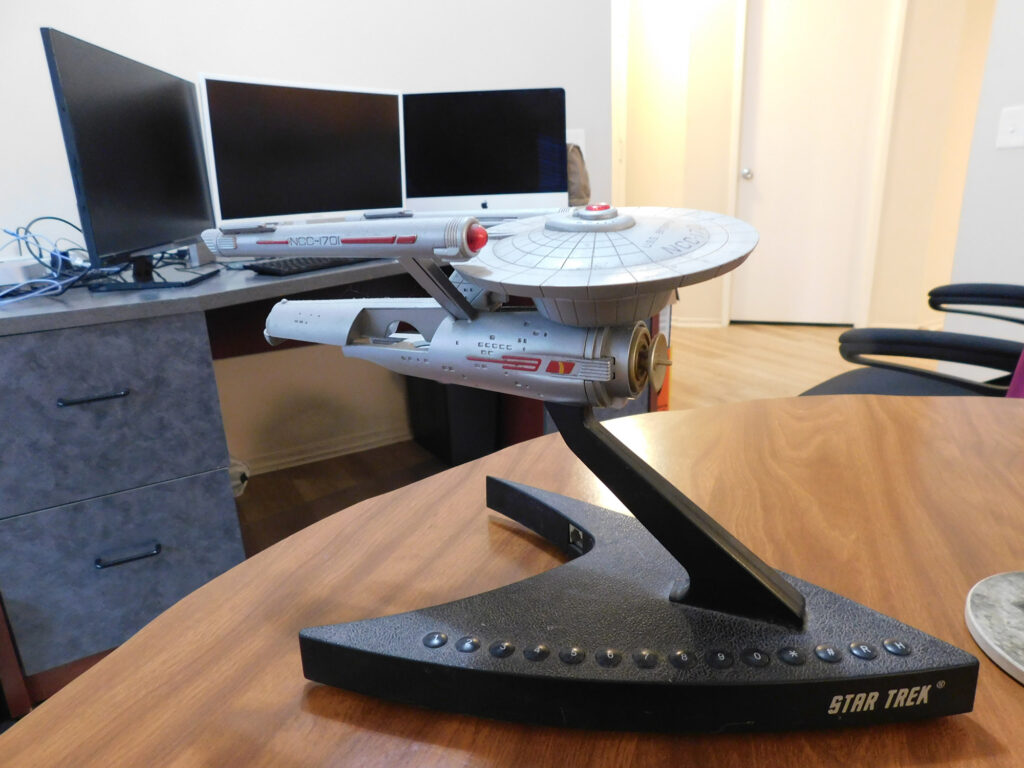
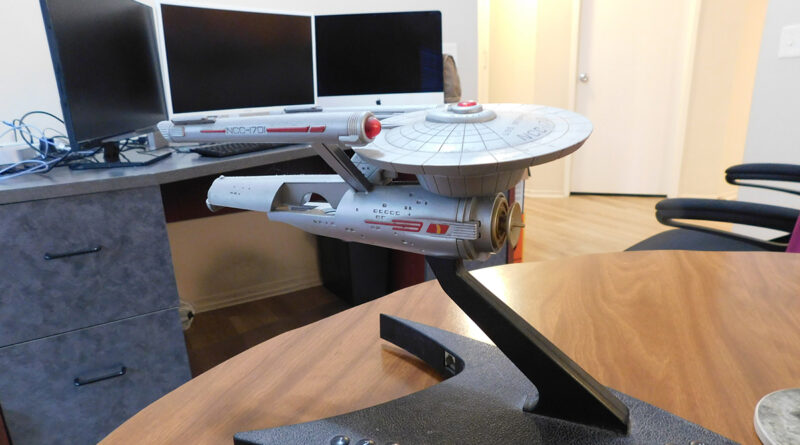
Twenty-first technology, represented by the Macintosh computers in the background, and 24th-century tech, depicted by the USS Enterprise, are used for similar needs. (Photo by Dave Mason / Region 4)